
How the Early County Court Calendar Works
The circuit’s Pataula Judicial Circuit official calendar points to a public KeepandShare month grid. That grid is the main calendar route for Early County. But it is not a case-index database. An event there may carry no case number. It may lack a county tag and docket history too. Read it as a date lead, then compare against the clerk’s record.
Seven counties share this circuit: Clay, Early, Miller, Quitman, Randolph, Seminole, and Terrell. The circuit is wide. That explains why a search can return a circuit event with no obvious Early label. Blank results happen too. A date filter can hide a setting. A missing event or a post-publication change can as well.
Superior and State cases work differently. The clerk and the Georgia E-Access route sit apart from the calendar. A listed setting proves nothing about the state of a filing, plea, or judgment.
KeepandShare Calendar Controls
The KeepandShare calendar view offers more than a simple month grid. You can switch views and narrow the dates. You can also add notes or overlays, and reset a filter that hid results. Those controls help when you lack a case number and only know a rough timeframe. Whatever the tool finds, the clerk still has to confirm the date before it matters.
| Control | Observed use |
|---|---|
| Views | Today, Day, Week, Month, Year, Event, Tag, and Timeline. |
| Search | Text prompt “What do you want to search for?” with a date filter, From, and To fields. |
| Range | View length choices from 1 through 8 and quick periods for January through December. |
| Advanced | Include Event Notes, Include Overlays, and a tag filter. |
| Output | OK, Print Results, Export Results, and Reset Search. |
| Navigation | Year links from 2019 through 2033 appeared in the inspected view. |
The public route also shows the calendar’s control screen with its search and filter options. Open the official KeepandShare calendar view to check the current controls yourself.
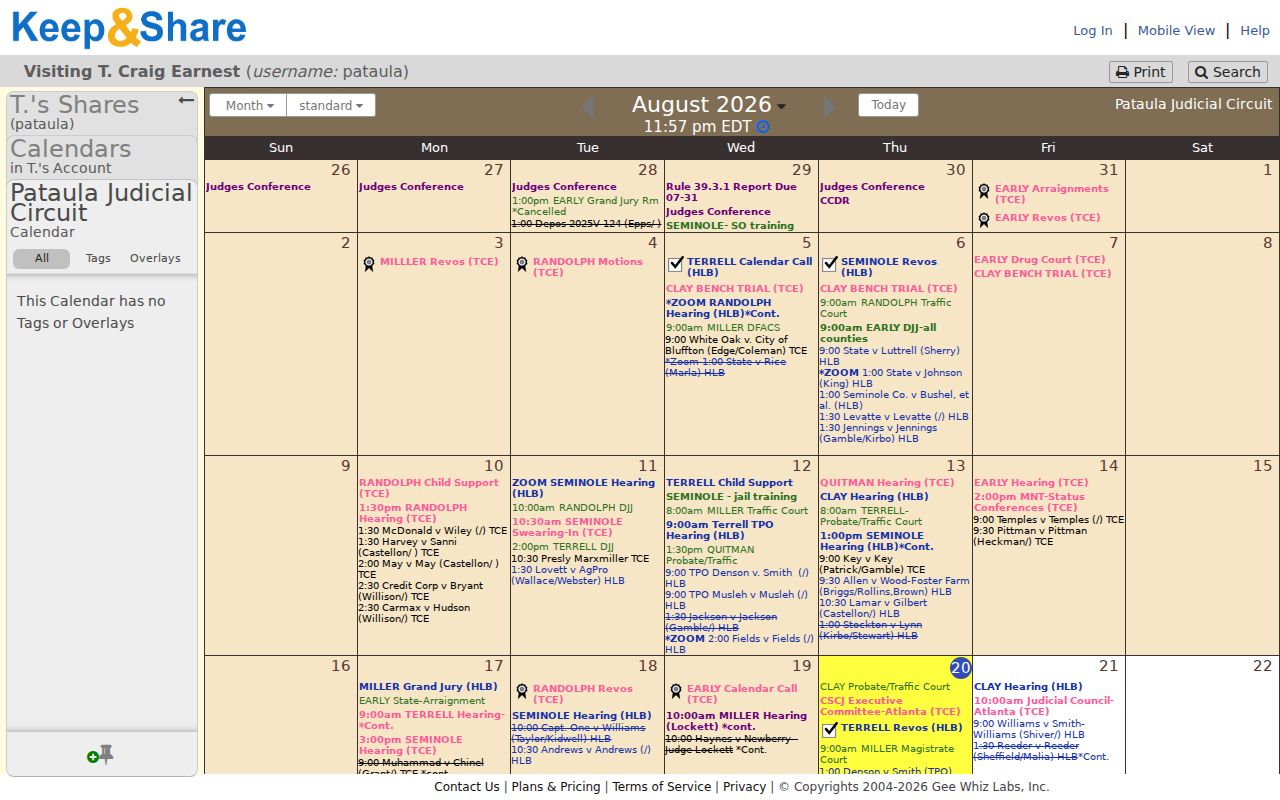
What you see there is a search and date-filter tool, not a complete Early County docket. Any date that affects a case needs clerk confirmation.
Early County Court Date Lookups
Work the channels in order. Start with the circuit calendar for any Superior or State setting. Is the event missing or the date off? Call Gayle Anderson’s clerk office at (229) 723-3033. You can also ask at the counter at 111 Court Square, Suite C. Or request the proper paper route. The clerk’s official contact page lists the mailing address and fax.
- Search the Pataula calendar by case text, court language, or a narrow date range.
- Check the Georgia E-Access route and the provider record when the case belongs to Early Superior or State Court.
- Call the Superior Clerk and ask whether the setting is current, reset, continued, or held by another court.
- Visit the clerk counter or ask whether a daily printed calendar can be inspected; no current county-filtered daily roster was captured.
- For a city citation, contact the issuing city court instead of treating the circuit calendar as the traffic record.
Probate, Magistrate, Juvenile, municipal, and federal settings each run through their own channels. A date search is only as good as the venue you pick.
Early County Arraignment Calendar Anatomy
The August 10, 2017 Early arraignment calendar is a helpful local sample. It names Early County Superior Court and July Term 2017. It lists Court Square in Blakely, Thursday August 10, and a 9:00 a.m. start. The sheet also carries a representation instruction. It has signature blocks for the judge and clerk. It even notes that cases continue hour-to-hour and day-to-day until dismissed.
Treat it as history. A party listed there tells you nothing about current status. A calendar appearance does not establish a charge, plea, outcome, or future date. The sample’s real value is its field anatomy. The fields run from court and term to place, day, time, case sequence, instructions, and official sign-off.
A current calendar may look different or drop fields entirely. When a paper sample and an online event conflict, ask the clerk. The clerk knows which current document controls.
Court Settings: What Each Field Means
Each field on a setting does one narrow job. The date and time say when the court expects the event. Courtroom and judge identify the venue. The setting type names the kind of appearance planned. Put together, they still say nothing about the result of the case.
| Date | The scheduled day. Check for a later continuance, reset, cancellation, or emergency order. |
|---|---|
| Time | The listed start or call time. Published calendars do not prove an exact minute of hearing. |
| Courtroom | The place named by the calendar or clerk. Confirm before traveling when the notice is old. |
| Judge | The judge shown for the setting, subject to later assignment or clerk confirmation. |
| Setting type | Arraignment, motion, trial, plea, status, or another event label with its own meaning. |
| Case identifier | The case number, style, or event text that ties the calendar item to a file. |
For a docket-level reading, set the entry beside the case record. Event titles get shortened, and the public calendar may not display the full filing history or access label.
Early County Calendar Distribution
The current Georgia Uniform Superior Court Rules lay out how trial calendars get built. The calendar clerk prepares one from the ready list. It includes place, date, and time. It is distributed or published at least 20 days before the term. Attorneys receive theirs electronically. Self-represented parties get theirs by mail under the rule framework.
That 20-day mark is about distribution mechanics only. A published date is not a promise the case will be called at that moment. Court order, continuance, dismissal, plea, or judge direction can all reshuffle the sequence.
An older Pataula rule mirror adds readiness and continuance language, including a possible monetary penalty. That mirror dates to 2015. Do not quote its penalty as a current Early requirement. Rely on the current rules and clerk confirmation instead.
When a Court Date Moves
A reset or continuance moves a setting. It does not end the case. Cancellations, dismissals, pleas, and new orders can all shift the next event too. So read the docket, the calendar, and the signed order side by side before you count on any single one. Whatever the order says last controls. An older printed notice may have told you something different.
Keep in mind that lawyers agreeing on a new date is not the same as the court approving it. A public calendar may lag behind the real schedule. The clerk's record and the signed order carry the true setting. Save the old notice for reference. Then jot down the new event type. That way you know what hearing you are actually walking into.
Weather adds one more wrinkle. Storm and emergency orders can move an Early County court date for reasons no notice predicted. If the calendar and a notice disagree, ask the clerk which order controls before you rely on either.
Storm Orders and Early County Calendars
Weather can move an Early County setting in ways no printed notice predicts. The Georgia emergency-order index and the January 2025 Pataula order show exactly how. The order closed the Early Superior, State, Magistrate, Probate, and Juvenile Courts for a winter storm. It reopened them on January 23. Deadlines that fell during the closure were tolled or extended.
So a setting slip does not settle everything. A calendar date has to be read against later court action. It cannot stand alone. A court date may land near a closure. Check the official order index. Call the clerk too.
What appears here is the statewide index route, not an Early daily calendar. The county-specific closure details live in the signed Pataula order itself. View Georgia's official emergency judicial orders whenever weather or a closure touches your setting.
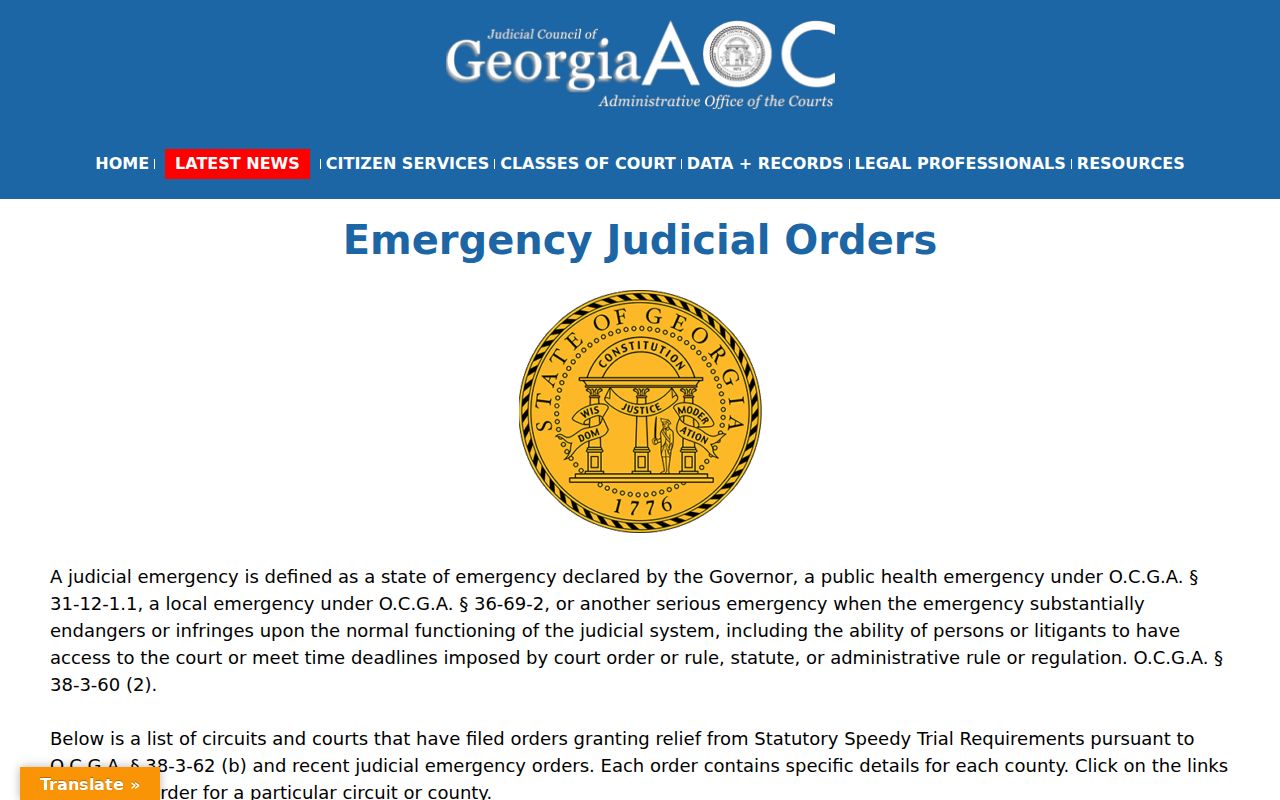
That index page lists orders, not an Early County day-by-day calendar. For the closure dates and terms that touched this county, the signed Pataula order is the document to read.
Missed Settings and What Comes Next
Missed a court date in Early County? Call the court or clerk named on the notice right away. A calendar search cannot tell you everything. It cannot say whether a failure-to-appear consequence, a new setting, a warrant, or some other order has been entered. Only the clerk can trace the case record. That call explains the next step. Treat a blank public calendar as a blank, never as an answer.
Act promptly: Keep the case number, the missed date, the court name, and any later notice together, then ask the responsible clerk what now controls.
The right office depends on the case. A city citation belongs to the issuing city court. Federal matters go to the Middle District of Georgia, Albany Division. Juvenile or sealed records face tighter access limits, so start that inquiry with the clerk or court office itself.
Early County Calendar Gaps
Early County posts no county-filtered daily docket PDF, courtroom bulletin, or docket-call roster on its official pages. That gap changes what counts. The live calendar and a clerk's confirmation are worth far more than any promise of real-time status. When you ask, request a sample. It should show the case number, party style, judge, courtroom, event type, and status fields. Then you know what the docket actually includes.
Remote access has its own catch. The Pataula video-hearing page asks public observers to contact the judge's office at least 24 hours before a proceeding. It still relies on a 2020 order. Confirm the current steps before you plan to watch. Ask whether the hearing is in person, remote, or hybrid. Also ask whether the public watches from the courtroom or through a current link.
The safest chain stays simple. Search the official calendar, then compare it with the case record. Verify with the clerk last. A printed date, an export, or an empty search result is one clue. It is not the whole court file.